
About i-Digital — Fuel & LPG Automation Specialists
i-Digital A.Ş. is a fuel automation company. We build the hardware, the firmware and the cloud software that run petrol, LPG and CNG stations, tank farms, delivery fleets and terminals — from the forecourt controller and the tank gauge to the truck register and the depot loading bay. The team has more than 20 years of industry experience, and i-Digital systems are live in more than 32 countries, with 450+ sites automated and 150+ trucks connected to the delivery platform. The whole chain is ours, so a compatibility problem has one owner instead of three suppliers forwarding it to each other.

Engineering for the fuel sector since the beginning
The company started in petroleum measurement and control, and that is still where the engineering effort goes. Controllers, level probes, register boards, RFID readers and the cloud platform behind them are designed by the same team, for petrol, LPG and CNG operations rather than for general industry — the full product range with specifications and models is listed together.
Fuel is sold by measurement, so dispenser and tank data has to hold up to a defined level of scrutiny. OIML R 117-1:2019 — Dynamic measuring systems for liquids other than water sets the metrological and technical requirements for fuel dispensers, for LPG dispensers for motor vehicles and for measuring systems on road tankers where legal metrology applies. It is the reference the engineering team works to when a dispenser reading or a truck register is questioned.
Most of the work sits in the parts of the operation a customer never sees: dispenser and pump protocols, i-Pro-C electronic register controller boards, sensor calibration, the data path from a forecourt cabinet to a head-office report, and how the system behaves when the network drops. Those are the parts that decide whether a site keeps dispensing or takes orders by hand.
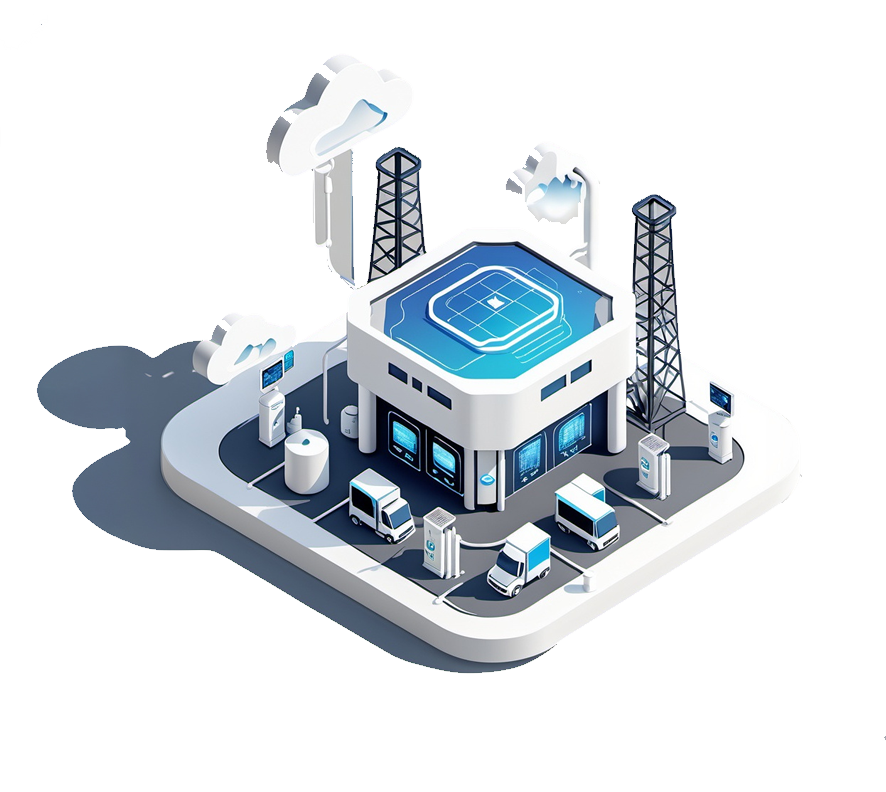
A fuel automation company that builds its own hardware and firmware
Owning the whole stack changes who answers the difficult questions. When the controller, the probe, the register board and the cloud platform come from one team, firmware updates, protocol changes and spare parts stay in the same place — and a field problem is diagnosed by the engineers who wrote the code, not by a distributor reading a manual.
i-Digital in numbers
The four figures below are the ones we can stand behind, because they are visible in the platform itself: how long the team has been in petroleum automation, how far the systems reach, and how much equipment reports into them.
More than 20 years of industry experience sits behind the current product family, and the systems run in more than 32 countries. Working across that many markets is not decoration — customer equipment differs from country to country, which is why one controller family handles a range of dispenser and pump protocols, and why the LPG panel reads tank level through both LPG level probes and Rochester gauges. Stock that will not reconcile usually has a findable cause; fuel variance: how to find and stop hidden fuel loss at your station works through the four places fuel goes.
450+ sites are automated with these systems and 150+ trucks report into the delivery platform — i-Truck delivery automation logs each of them with its location. The practical meaning for an operator is that this architecture has already been installed on sites that are not ours, with dispensers and tank gauges from other manufacturers, under other national rules — not only in a demonstration.
What working with i-Digital looks like
Six things decide how a project runs here. They are worth reading before a first call, because they set the sequence and the scope.
Tailor-made, not boxed
Systems are designed around the operation: which pumps, tanks, trucks, terminals and back-office systems already exist, and what has to change. Two operators rarely need the same module order — one starts with the forecourt controller and the tank gauge, another starts with the delivery fleet. Scope is agreed per site, not as a fixed package.
Full stack development
Firmware, embedded hardware and cloud software are developed in-house, so one team owns the reliability of the whole system. That covers the forecourt controller, the LPG control panel, level probes, register boards, RFID readers and the platform they report into. When something does not behave, there is no question of which supplier’s part is at fault.
Built for fuel environments
Our embedded hardware is purpose-built for stations and terminals — immune to the virus attacks and operating-system crashes that affect PC-based solutions. The controller is built for a forecourt cabinet rather than for a desk, so station operation does not depend on a PC that can be restarted only when the site is quiet.
International deployment
Systems operate in more than 32 countries, in different fuel markets and regulatory environments. Support and commissioning come from our engineering team, and the installations stay connected to the cloud platform, so many faults are diagnosed remotely before anyone travels. A site outside Türkiye does not need a local dealer for a first-line diagnosis.
Integration first
Existing dispensers, tank gauges, payment terminals and ERP systems are integrated rather than replaced wherever the protocol allows. A station can be modernised in stages without stopping trade — that is how our turnkey automation for petrol and LPG projects are sequenced — and an operator with several sites can move one site at a time.
Support that knows the product
Support comes from the engineering team that built the system, through technical support and the helpdesk and remote diagnostics. The head office is at GOSB Technopark, Gebze, Kocaeli, and the helpdesk runs Monday to Friday, 9:30–17:30 (GMT+3). Because the site is cloud-connected, the alarm and the tank reading you see are the same ones the engineer reads before a visit is arranged.
Frequently asked questions
How long has i-Digital been operating?
The team has more than 20 years of industry experience in petroleum and automation, and i-Digital systems are deployed in more than 32 countries. 450+ sites are automated and 150+ trucks report into the delivery platform.
Where is i-Digital based?
The head office is at GOSB Technopark, Gebze, Kocaeli, Türkiye — I DIGITAL Y.D.O.B. SAN VE TİC. A.Ş., GOSB MH K.NEHROZOGLU CD. NO: 507, 41400 Gebze, Kocaeli. Commissioning and remote diagnostics are handled internationally from there by the engineering team.
Do you build custom systems?
Yes. The team designs both the hardware and the software, so a system is adapted to how a station, terminal or fleet actually operates. Dispensers, tank gauges, payment terminals and back-office systems that are already installed are integrated wherever the protocol allows, instead of being replaced.
Can you support customers in other countries?
Yes. Systems operate in more than 32 countries, and support and commissioning come from the engineering team that built them. Because the installations are cloud-connected, many faults are diagnosed remotely before a site visit is arranged.
Which systems do you make?
The family covers the forecourt controller (i-Console cloud-based forecourt controller), automatic tank gauging (i-Level ATG automatic tank gauge with i-LS magnetostrictive level probes), the LPG station control panel (i-Control), truck delivery automation (i-Truck), terminal and depot automation (i-Terminal automation for terminals and depots), the outdoor payment terminal (i-Pay outdoor payment terminal), MIFARE RFID identification (i-Reader MIFARE RFID reader), the register controller board (i-Pro-C) and the JCM online fuel station management platform.
Do you work with CNG as well as petrol and LPG?
Yes. The same controller family covers petrol, LPG and CNG station automation. LPG stations add the i-Control LPG station control panel, which brings gas sensor and emergency-stop inputs into the same installation.
Transform your fuel business with our solutions.
Tell us what you operate — station, terminal or fleet — the dispenser and tank gauge brands already installed, and what you want under control first. The engineering team answers with the modules that fit your site and the order to install them in.